Tuesday, May 16, 2006

A Supercross Season for the Ages

My son and I just got back from maybe the best sporting event I will ever attend - the 2006 Las Vegas Supercross.


Now this is no small thing. I was in the audience in Logan, Utah when Utah State University upset Brigham Young by the score of 58-56 in football. It was against the rules in that game to play defense. Oh yes, that game rocked.

I should say, it rocked, unless you have the sorry lot of being a BYU fan - but then, if you were, you wouldn't be reading this blog. This blog is for half bad boys, not sissy pansy-waists. As anyone knows, if you wish to attend BYU, you must agree to adhere to the code of conduct, part of which reads, "I vow to consider myself superior to everyone else," and another part which reads, "I disavow myself from ever being a half bad boy; rather, I vow to be a sissy pansy-waist."
If you ARE a BYU fan and happened to arrive here by accident, I apologize. I recommend you try http://self-righteous-sissy-pansy-waists.blogspot.com/. That is probably where you meant to go anyway.


Another great sporting event right after BYU's guard tandem of Randy and Robby Reid were featured in the Sports Illustrated Swimsuit Issue. No, they were actually featured for their supposed basketball prowess, not for being sissy pansy-waists. Although it was later said of them, "The two biggest boobs in this year's SI Swimsuit Issue are Randy and Robby Reid."

Anyway, BYU came to Logan where a complete unknown point guard named Roddie Anderson completely schooled the Reids for 40 minutes as USU routed BYU by like 20 points.


Amazingly, many of my great sporting moments revolve around USU upsetting BYU.


But I digress. As I said, I took my son to the 2006 Las Vegas Supercross, where Chad Reed and Ricky Carmichael came into the event tied for the lead in points with James Stewart only 5 points back. The buildup was awesome and so was the racing. In the Supercross class main event, it all came down to the start. Chad was the fastest of the night, but it was only by tenths. By the end of lap two, Stewart had a 3 second lead on Carmichael, who had a 3 second lead on Reed, and that is how it ended.

I was disappointed, sure, because Chad didn't pull it off. But in true Chad Reed style, he was gracious, appreciative of the opportunity, respectful of the other two champions, a good sport, and above all, he remembered to thank his wife Ellie.


And I got to experience it all with my son. Nope, I'll never forget that one for sure.

Friday, April 21, 2006

Understanding Generative Thinking Part 3 (or, How to Prove Your Point with Diagrams)

(If you have not read parts one and two, you probably should do that first.)

One of the great things about generative thinking is that it allows you to prove your point with diagrams. Notice here that I did not say, "demonstrate" your point. I said "prove" your point.

With generative thinking, if you like, you can draw a diagram that discusses your point. This is not that big of a deal. The big deal is, if anyone disagrees with your point, you can reference the diagram you just drew as proof that you are right!
Remember, part of generative thinking is that they have to accept whatever you say without questioning it. And don't forget the advantages of shouting!

Here is a real world example of how this actually happened. I am not making this up. I have several witnesses that can vouch for the validity of this experience.

The topic of discussion was, communicating issues between individual contributors and management. The question was asked, "I don't always feel comfortable communicating problems to my upper management. Sometimes I am asked to do something; I see a problem, but I am unsure how to communicate this problem to them effectively. Do you have any suggestions?"

It is very important that you do not forget this question, because it will NEVER BE ANSWERED.

Here is how the question was addressed.

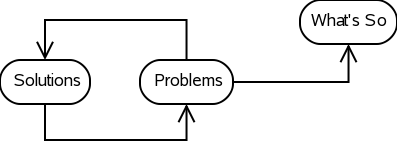
"Well, let's take a look at this. What you don't want to do is try to solve problems. I'll show you." And she drew this picture. "See, here you have your problems."


"There's something about problems. What do problems lead to?"
We answered, "Solutions."
"That's right. Solutions." And she drew this next picture.


Then she went on. "See, the thing about problems is, in order to address the problems, we come up with solutions to the problems. But what happens when you come up with solutions? You simply find more problems!" And she drew this picture.

At this point, one person in the class took exception. "Uhh, well, I don't agree. Sometimes, you identify a problem, and you solve it, and it just stays solved. Then you move on."

Silly student! That is thinking about, not thinking for! The instructor of generative thinking is always right!

She returned to the board again. "No, I'm sorry, that is not correct. As you can see here on the board, problems lead to solutions, which lead back to problems. It is a vicious cycle. You don't want to get caught up in trying to solve problems!"

Let me just say that not only will you not get very far telling software engineers, whose job it is to solve problems, that solving problems is a no-win game and a bad idea, but also it didn't really fool anyone that she had just drawn a picture, and then used the picture to prove her point of view. Very interesting!


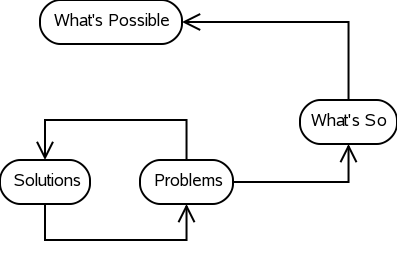
She went on. "Instead of trying to solve problems, you want to identify the 'what's so.'" She drew this picture. "You separate the fact from your opinion. That is what it means to identify the what's so."

(See, you can't trademark the word "facts." I wouldn't be surprised if "what's so" is a trademarked term.)


Next she drew this picture. "When you identify the what's so, then you come up with what's possible. This opens you up to discover creative ways of addressing the what's so." You see, no solutions to problems are ever creative!

Anyway, because you have identified the "what's so" and have now had many edifying conversations about "what's possible," I'm sure you are wondering what happens next. So were we.


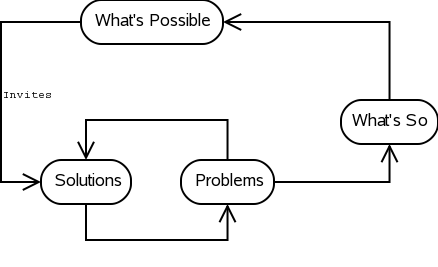
"Now that you know what's so and what's possible, the great thing about this is, it invites solutions." And she drew this picture.

No, I'm not kidding.

We looked on in astonishment as we saw that we had just completed a larger circle. Most of us were truly trying to see this from her point of view and validate it. But we couldn't help but notice that all we did is add two extra steps to the infinite loop we had originally!

As best I can tell, what this picture points out is the following: "Problems lead to solutions, which only lead back to more problems. This is how you address problems on your own. If you want to involve management, you must first identify the what's so. Then you communicate it to management who tells you what's possible. What's possible might include things like, "If you don't solve that problem, it is very possible that you will get fired." Or, "If you don't have enough time to solve that problem, it is very possible that you will need to work late nights." Such possibilities obviously invite you to come up with a solution, any solution, to the problem.
And you're right back where you started.

The moral of the story is, involving management in problem solving involves twice as many steps and takes twice as long. Otherwise, you can spin faster if you just deal with it yourself!


I related this story to my friend Brandon. After he wiped the tears from his eyes and got his breath back, he posited the following:

"The thing is, a problem is not an oval, it is a triangle. Each side of the triangle represents the three sides of the problem - my side, your side, and the truth. We draw a line out of each side of the triangle to represent the three sides of the problem. There is a circle that touches each of these lines. The circle represents you. Outside of you is a larger circle. This represents upper management. To solve a problem, then, you simply draw dots in the space between you and upper management. There. Problem solved."

Here is the picture he drew:


We now call this the Hubcap Methodology of solving problems. And don't go using it all over the place, willy-nilly. We are trademarking it.

Thursday, April 20, 2006

Understanding Generative Thinking Part 2 (or, How To Teach Without Lesson Planning)

One of the really great things about teaching generative thinking is that it doesn't require a lesson plan. (See Part 1 of this series if you haven't already.)

It doesn't require a lesson plan, because you start out by telling the audience that they just have to accept what you say as a valid point of view, and they aren't allowed to question it or debate. This makes it so you can get paid to pontificate, philosophise, and otherwise b.s. your audience about whatever your opinion is on anything you want. They will just sit there and try to make sense of whatever drivel falls out of your mouth, knowing that they can't question or debate it.

When you are done talking, nobody will dare say anything, because what they want to say is, "What in the crap are you talking about?" But only you are allowed to say such things. Either that, or they are expecting you to continue, because they expect you to make a point. But you don't really have a point, other than to talk about whatever enters your head. So you can sit there in silence for a while. After a while, you can say, "You people are not thinking loud enough." What this really means is, "Someone make a comment, so I can philosophise about it."

Now you might be wondering, "But what happens if someone expresses an idea that I don't want to talk about, or asks a question that I don't know the answer to?" Ah, my young Padowan. Fear not! It is at this point that you pull out some of your key phrases, like, "You don't have to understand it. Understanding is the booby prize," or, "You need to remember to listen and speak for, not listen and speak about." This last one is very key, since nobody in the room knows the difference between the two, and you never explain it to them. And since it is against the rules to try to understand or question it, they have to just accept it.
Another technique at this point is to begin the insults. For example, say, "I can't believe how insistent you guys are at getting off topic." This will let the audience know that the comment was not appropriate. They may not know what the topic is, but they know that the last comment was NOT the topic.

What they haven't learned yet is that the topic is whatever YOU want to talk about. The comment was on something that you don't want to talk about. Obviously that makes it off topic.


You might believe this to be made up, but I swear this actually happened. After coming back from a break, the instructor leads off the discussion basically by asking, "What have you guys been thinking about what we've been learning?" You might assume this is intended to be a 10-minute segue into the topic at hand, but no - this WAS the topic at hand, apparently, as we discussed apparently whatever the instructor wanted to talk about for over one hour. Then someone made a comment or asked some sort of question. The response came back, "You know, I cannot believe how devoted you guys are to getting the conversation off topic. We are trying to head somewhere, but you guys are bound and determined to dive down ratholes and spin on off-topic conversations."

To which we replied: "How can we go off topic when we don't know what we are even talking about or what we are trying to achieve?"

As best we could tell, it was off-topic if it was about something the instructor didn't want to talk about.


So again, this is a powerful tool. You could get paid to train people without actually teaching them anything. For example, you could make up a bunch of stuff about how similar the world economy is to a Chia Pet, or why gravity is a farce. If anyone disagrees with you, you can reprimand them for not listening to your point of view and accepting it as valid for you. If they ask a question about it, you can remind them that understanding is not the purpose. And if you get tired of talking about it, you can just be silent, and wait for them to say something. If they bring up something you want to talk about, you can talk about it. You are even welcome to disagree, if you like; as you'll remember, you don't have to follow your own rules. Or, if it is something you don't want to talk about, you can just claim that it is off-topic.

This way you can talk about whatever you want and get paid for it.

Wednesday, April 19, 2006

Understanding Generative Thinking, Part 1 (or, How To Get Paid To Teach Bunk)

I just finished a training course on generative thinking. Before I go any further, I must say that I feel I did learn skills, techniques, and information of value in this course. So if you ever are asked to take such a course, I'd say to do it; just be aware of what it is. To be clear - there is some value here.

I also have to say this is probably (and intended to be) the first of a series of blogs about this. It's too much information for one blog, and I have to get this written down in order to calm down about it.


Okay. Now, to talk about Generative Thinking Part 1, or How To Get Paid To Teach Bunk. Don't take this to mean that the whole thing is bunk. For example, you will find that this is a sort of a Jedi mind trick to help you win arguments.


1. Build a basis that defines itself with circular logic. For example, a basis where, in order to use what you learn, you have to first put it into practice; in order to understand it, you first have to make sense of it, etc. In this case, make a claim that you are going to teach techniques on how to communicate effectively, and then require them to master these skills before they can learn them.
2. Establish a precedent for listening. This is an important piece of foundational information which sets a stage where only you have the right to talk. Express that in the class you will be presenting an idea that they need to just try to accept as a possible reality. This will come in useful later.
3. Invent a vocabulary. Use phrases like "listen for, don't listen about" and "give granted trust, not earned trust" that don't really make any sense. Explain to the class that what this means is that you just decide to listen to and accept another point of view as valid for them. What you really mean is that you are exerting the right to say whatever you want and the class rescinds their right to question not only your information but also your reasoning.
4. Claim that understanding is the "booby prize." I recommend you specifically use these words. This way, whenever someone asks a question such as, "I don't understand what you just said," you can use this so you don't have to repeat yourself. Instead of trying again to teach it, you can simply say, "Well, understanding is the booby prize. You don't need to understand it."
5. Claim that things are the way you perceive them because you say so. By the way, you have to subtly make it clear that this rule only applies to you, not everyone. If you explicitly say so, they might call you on it, in which case you'll have to resort to rule 6. If you are subtle about it, they might not figure it out until the class is over.
6. If things don't go your way, use emotion, shouting, threats, and/or insults to get your way. Most people will respect an instructor as a position of authority without requiring any demonstration of why they should respect you. So you can use these manipulations as a way to guilt them into submission. For example, if someone asks a question that you don't want to answer, you can say something like, "I can't figure out what is wrong with you people, why you always have to understand everything." Or, if the question they ask exposes a flaw in your teaching, you can become angry, shout at them in front of the whole class, and claim (at a high volume) how disappointed you are that, after all this time, they still insist on being argumentative instead of just listening to what you have to say. You might think this is a bit hypocritical, but move on to #7.
7. You don't have to obey your own rules. You can pick and choose when you want to obey them. For example, you can tell the class that while two people are conversing, everyone else has to listen; but you can interrupt if you want to. You can explain to people that they should take emotion out of their confrontations, but then you can become angry, rude, and condescending (see #6). You can insist that people listen to you, and yet when they talk, you don't have to actually listen to their point of view; instead, you can claim that they are not listening to you.
8. Master key phrases. Some of them are, "You are putting words in my mouth." "That is your opinion, not a fact." "You aren't listening, you insist on arguing with me." Here is an example of how to use them:
Student: "I have a concern about what you have said. If I were to do that, I would get fired."
You: "That is your opinion, not a fact."
Student: "Well, no, it is a fact, because my boss told me, 'If you do that, you are fired.'"
You: "You aren't listening, you insist on arguing with me."
Student: "I feel like you aren't listening to me. You said that I should do (x), and all I did was express a concern about my job."
You: "You are putting words into my mouth."
Student: "No I'm not, I'm trying to understand what you said."
You: "Understanding is the booby prize. This is not about understanding."
Student: "Well, I don't know how I can use something if I don't understand it."
(This is the point at which you start shouting.)
You (shouting): "I have never, in all my years of teaching this course, known anyone so belligerent and insistent on arguing with me as you. You absolutely refuse to learn what I am trying to teach you. Maybe you'd be happier if I just declared this my first ever failure in trying to teach. This is something that you could obviously use, but you simply refuse to learn it."

If you follow all of these steps, more or less in order, you will arrive at nirvana, as long as you define nirvana as: A state where you are always right simply because you assert that you are right, and nobody can challenge you because they rescinded their right, and if they try to, you will beat them into submission.


Can you see how powerful this is? This is a technique wherein you don't have to answer questions that are hard, you can become offended and shout and insult people if they question you, and you don't have to actually succeed in making them learn anything. Powerful! You could create a consulting firm, teaching this stuff to corporations for large sums of money, and nobody could ever prove you wrong - at least, not without getting into a shouting match. Well, you are too late for that, because people are already doing it. But, it could be a great technique for winning arguments.

Tuesday, April 11, 2006

TLC Life Lessons - Don't Be Fooled

Maybe you've seen these new TLC Life Lessons commercials on TV lately. They advertise these figurines with "life lessons" printed on the bottom. They are admittedly kind of funny, but I've come to the conclusion that they were all written by women as a subtle message to try to change men into what they think they want.


Take this one for example. The text on the bottom of this one says "When she asks for a backrub, sometimes she just wants a backrub." Of course, all of us half bad boys know this.
We also know that the caption is not complete. The complete caption should read, "When she asks for a backrub, sometimes she just wants a backrub. And sometimes she wants more than a backrub. In either case, she lets you know by saying, 'Would you give me a backrub?'"
Now, check out the guy on this figurine. Does he look like a half bad boy? Does a half bad boy wear silky boxers with hearts on them? Give me a break! This guy probably listens to Barry Manilow.

Women don't get this quandary. I even explained it to my sigoth and she didn't seem to understand the problem: If "sometimes" she only wants a backrub, how are we supposed to know which of the "sometimes" she only wants a backrub?

Well, I'll tell you - it is part of a plan to trap and frustrate you. Don't be fooled. These and other messages are intended to confuse men and women and to complicate the relationship between us, not sweeten it. Believe me - as much as women complain about men vocally, they have been created to be attracted to men, and vice versa, by our very natures. If you believe in God, then you can believe we were created that way; if you don't, then you must believe that millions of years of natural selection have led us to this point as a species.

Don't get drawn into this. Be a manly man. Be a half bad boy. Respect your sigoth and support her, but don't give into this societal attempt to turn a man into a demasculated, hypersensitive, feminine version of his former self. She might complain that you don't cry with her in that chick flick you suffer through for her sake, but trust me - she will appreciate you being a rock when her emotions are all shot to hell. She really wants a man, despite what society tries to tell her. Hang tough my friend.

By the way, the figurines are funny, and you can buy them online if you are so inclined.

Thursday, March 30, 2006

Response to Congressman Cannon

I have to admit being rather impressed that Mr. Cannon would write back to me specifically (or more likely, that he would instruct one of his office staff to write back to me specifically - either way I feel somewhat heard).

Still, you can't help but love some of the comments in the e-mail. Such as, "This legislation is designed to address the generally held concern for the 'Analog Hole Problem.'" "Generally held concern?" I hadn't realized that the general public was deeply concerned about the fact that they can legally record copies of their favorite shows. More likely, I suspect that the "generally held concern" would be that this freedom would be taken away.

I also love this phrase: "usage rights negotiated through voluntary agreements." Tell me - when was the last time you negotiated a voluntary usage agreement for a CD, a DVD, or a television program? Where is the contract you signed or the license agreement you agreed to adhere to?

Another good line is: "there is nothing to prevent manufacturers from taking advantage of the Analog Hole and allowing unrestricted copying and redistribution of content." Agreed. And there hasn't been since the start. And this act is not going to stop people from making and redistributing copies of protected content, trust me. But at least now we are getting somewhere.

Here's the point - this is a law that takes freedom away from the law-abiding citizens and does nothing to really prevent the criminals from committing crime. If we assume that people are not idiots, the only other assumption we can come up with is that those promoting this bill know it won't prevent piracy - instead, it is about greed, power, money, and control, primarily that you and I have less of these and give more of these to the government and to wealthy corporations.


Anyway, here's my response to his e-mail:

Dear Congressman Cannon:

Thank you for your response to my concern. I can tell by reading your response that it is tailored to my concerns, as opposed to a general-purpose form response. I was impressed to see a response that was tailored to my concerns.


I appreciate that you would take the effort to explain this problem to me. As a professional, senior-level software engineer with over ten years of experience, you can be assured that I have a pretty firm grasp on technology, digital rights management, patents and copyrights, and other issues surrounding intellectual property.


I have argued both sides of these issues in my career and have seen many valid points on both sides. I have many concerns about intellectual property administration and policy in general in our country; much of this has to do with our country's future in a world economy and our ability to continue to compete.

I won't get into all of these issues because it will take even longer than what is already stated herein. Instead of delving into the issues of this bill at hand, I prefer to keep the details out and discuss what is happening in general terms.


What is happening in general terms is that certain corporations have identified a means by which people COULD steal from them. The capability to steal their property is not new (people have had this ability for decades), but the ability to prevent it IS relatively new. Thus, they are asking to pass a law that makes it so people cannot choose to steal from these companies.

This is my key area of concern. My problem with this is that, at a fundamental, moral, and religious level, I think it is wrong to enact law that takes away an individual's freedom to choose, even if it is to choose to commit a crime. Do I think that people who steal should be let free? No; on the contrary, I depend upon the laws of our country to uphold penalties for stealing intellectual property, or I would otherwise lose my livelihood.

But what we are talking about here is passing a law so that people won't be able to commit a crime. This is a different case, and I think it sets a dangerous legal precedent. You said that you have "always tried to outlaw piracy." Congressman Cannon, piracy is already outlawed. This bill is not about outlawing piracy; it is about removing freedoms from the law-abiding majority in order to prevent some people from committing piracy. What comes next? Disallowing people to host their own blogs because they might post child pornography? Outlawing the ownership of firearms because someone might use one to kill someone else? Revoking all driving privileges because someone might use a car to get away from a bank robbery?

In addition to these moral concerns, I do not think that such laws will work out as we believe they will. If the innovation to legally circumvent such restrictions or provide alternative solutions doesn't originate within the United States, I believe it will elsewhere, which will be worse than having to deal with the stolen IP in the first place.


It is better to let these corporations learn how to adapt to a new market and to new consumer demand. If the economy is like a natural ecosystem, then corporations in that ecosystem are like animal species. The ecosystem becomes more robust only if natural selection is allowed to run its course. Corporations that can't innovate to meet new consumer demand shouldn't be able to rely upon the government to save them from having to evolve.
Imagine if the wagonmakers of 100 years ago had successfully rallied together and lobbied Congress to enact laws making automobiles illegal. They may have stated a noble premise (say, because automobiles are more unsafe than wagons, which is probably true, or that they would make it easier to commit crime, which is probably also true), but you and I know what the real reason would have been - to preserve their line of business.
Imagine if they had been successful. Not only would we still be using horse and wagon, but there are many other ways our society would have changed as a result. Our cities would be smaller and more crowded, since people couldn't live more than a mile or two from employment. And how many hundreds of thousands of Americans are employed today because of the automobile industry, either directly (manufacturing, design, testing, etc.) or indirectly (parts, petroleum, highway construction, tire manufacture)?
We can see that this would have been a devastating step to take. More likely, this innovation would have occured in another country, and we would have cars today, but we would not have had the economic benefit like we have had.

This situation is no different fundamentally. Corporations are asking for law to be passed so that they don't have to compete or evolve. This is a short-sighted view that is detrimental to our long-term viability. It is wrong on an economic as well as at a moral level. I urge you to help our Congress understand the danger of such laws and to cease consideration of this bill. I appreciate your consideration and responsiveness to my concerns thusfar.

Warmest Regards,

Matt Ryan

Letter From Congress On the Digital Transition Content Security Act (DTCSA)

If you read my blog you'll remember this earlier post on the DTCSA. I fear that someday we will all be rolling that acronym off our tongues as slickly and contemptuously as we say DMCA today.

Anyway, I thought you might be interested to read the correspondence I have had thusfar with Congressman Chris Cannon, who is the US Congress representative from where I live.


Here's a letter I received back from him on this subject:


Dear Matt:

Thank you for contacting me about H.R. 4569, the Digital Transition Content Security Act (DTCSA). It is good to hear from you.

This legislation is designed to address the generally held concern for the "Analog Hole Problem" that occurs when the usage rights negotiated through voluntary agreements that are applied to high value digital content basically disappear when that digital content is converted into analog form. Content is "in the clear" once it has been converted to analog form. Unlike encrypted digital content, where access to the decryption keys can be subject to particular content usage obligations, there are no keys, licenses, or contractual obligations required to access and manipulate unencrypted "in the clear" analog content. Currently, there is nothing to prevent manufacturers from taking advantage of the Analog Hole and allowing unrestricted copying and redistribution of content that originated in a protected digital format.

The purpose behind the legislation is to preserve the same usage rights when video content is digitized as would have applied had the content not been stripped of its usage rights information in the format conversion process. For my part, I have always tried to outlaw piracy while trying to maintain fair usage rights for consumers. My position on the Judiciary Committee has given me the great opportunity to advocate for technological advances while working to clarify copyright law.

I am weary of government mandates on technology, believing that manufactures should do most of the negotiating. I do not believe it is the role of government to pick the winners and losers among different technologies. The preferred method is always private sector solutions to\ncontent protection issues. The market is generally well-suited to deal with the usage issues surrounding digital content, and it is doing so on many fronts.

Thank you once more for expressing your concerns. I will examine this bill, desiring to leave to the market what can be solved in the market while ensuring consumer choice and a level playing field for manufacturers. You raise legitimate questions that I will keep in mind as this bill and other Intellectual Property issues are addressed in the House of Representatives.

If I may be of further assistance, please do not hesitate to contact me. For more information on issues currently in Congress, please visit my website at www.house.gov/cannon.

Warmest regards,

Chris Cannon
Member of Congress

Monday, March 13, 2006

The Rock is Rolling On

That to-be-expected but nonetheless-saddening day arrived - Mike LaRocco has retired from professional racing.

I actually have Mike LaRocco's autograph. Don't laugh. I had to wait in line a long time to get it.

I don't want to wax poetic about Mike LaRocco. Something about LaRocco and poetry don't seem to mix, anyway. Let's just say, this guy is a true half bad boy. Supercross racer, hard worker, good father, and married to a babe - what all us half bad boys aspire to (and, at least the being married to a babe part, some of us have accomplished - like me).

Mike's had some great moments, but his last win at Indianapolis in front of his home crowd was one of the best in all of Supercross history. You'll be missed, Mike.

Chad Reed is the Man - Again

Ok, I know that RC won Daytona, pretty handily in fact. But the Half Bad Boy award has to go to Chad Reed. He took second place - with a separated shoulder?! This guy is one tough mother.

Hats off to Chad for a gutty performance at the toughest track of the year to stay right in the thick of the points battle.

Oh, and for those of you that say, "Well, Stewart would have beaten Chad if he hadn't crashed." I got news for you - Stewart crashed. Crashing is a part of the sport. The winner is whoever can get through 20 laps the quickest, not whoever can post the fastest lap time. You might as well say, "Stewart would have beaten Chad, if he could have completed the race before Chad." In other words, it is a dumb thing to say, so don't say it.

Way to go, Chad. You rock. Keep toting the banner for us half bad boys.

Tuesday, February 21, 2006

Half Bad Boy Hero - Chad Reed Wins St. Louis

Let me be the first to congratulate Chad Reed on his awesome victory in the St. Louis Supercross. What's that you say? He's already been congratulated? Well, then I guess I won't be the first to congratulate him. I want to do it anyway.

Chad Reed is a true half bad boy hero. He participates in one of the most bad-boy sports on the planet, and does so at a top level. He expects nothing less than the best of himself, but he truly loves the competition. And who was the first person he thanked on the podium this week? His wife Ellie.

Oh yeah. That's what a half bad boy is all about.